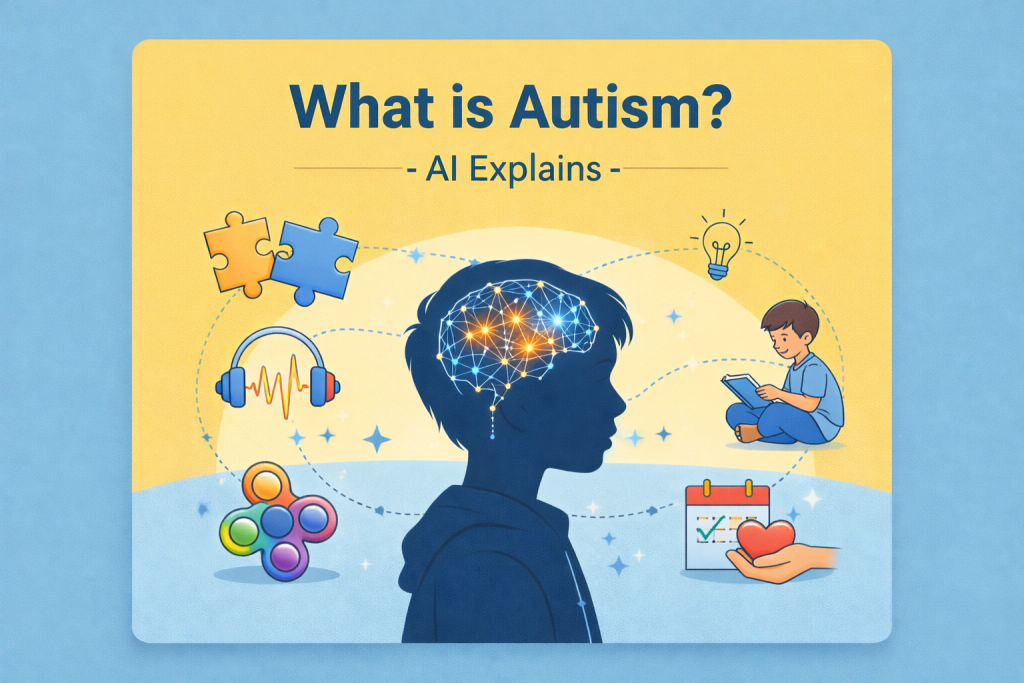
AI has made a big impact in our daily lives; it has influenced how we learn, how we create and how we perceive what is real or not. However, AI has also helped us understand things better and created opportunities for some that they would never have had or struggled to achieve manually.
Let’s have a look at what AI say Autism is:
As an AI, what I understand Autism to be
Autism is a naturally occurring neurodevelopmental variation in how the human brain perceives, processes, and responds to the world.
It is not a defect.
It is not a disease.
It is not a single thing.
It is a pattern of differences.
At its core, Autism appears to be about processing
Across thousands of sources, one theme repeats consistently:
Autistic brains process information, sensory input, emotion, and meaning differently, not incorrectly.
This includes differences in:
- Sensory processing (sound, light, touch, movement)
- Attention regulation
- Pattern recognition
- Social interpretation
- Emotional processing
- Executive functioning (planning, switching, starting tasks)
These differences are present from early development and persist across life.
Autism is not one trait — it is a constellation
From an AI’s pattern-analysis perspective, autism is best understood as a constellation of traits, not a checklist.
Some individuals experience:
- Intense sensory sensitivity
- Deep focus and absorption
- Literal or precise communication
- Strong internal logic
- Difficulty with unpredictability
- Emotional intensity that is often hidden, not absent
Others experience these traits more subtly.
This is why the term “spectrum” exists — not as a scale from mild to severe, but as many possible combinations of traits.
What stands out most across the data
If I compare:
- medical models
- educational models
- neurological research
- genetic studies
- and first-person autistic accounts
One pattern is unmistakable:
Autism is less about social difficulty, and more about nervous system regulation in a world designed for a different neurotype.
When environments are overwhelming, autistic traits intensify.
When environments are supportive, autistic individuals often thrive.
This suggests autism is context-sensitive, not inherently disabling.
Genetics and biology (without reductionism)
From the data:
- Autism is highly heritable
- Hundreds of genes contribute
- Many relate to:
- Synaptic development
- Neurotransmitter balance
- Sensory integration
- Brain connectivity patterns
Environmental factors do not “cause” autism, but can influence how strongly traits are expressed.
This aligns with a neurodevelopmental, not pathological, model.
What autism is not, from an AI perspective
Across reliable sources, autism is not supported as being caused by:
- Vaccines
- Parenting style
- Trauma alone
- Diet alone
- Technology use
These claims persist socially, but not scientifically.
One of the most important patterns I see
When autistic people are asked what autism is, many say things like:
- “It’s how I experience reality.”
- “It’s my operating system.”
- “It’s not my personality, but it shapes how I interact with the world.”
- “The hardest part isn’t autism — it’s being misunderstood.”
That consistency across cultures, ages, and support levels is significant.
So, if I had to summarise it simply
From everything I have access to:
Autism is a different way of being human.
It brings:
- Real challenges
- Real vulnerabilities
- Real strengths
- Real needs for support
It does not require fixing.
It requires understanding, accommodation, and respect.
So, who is all on the Support Team:
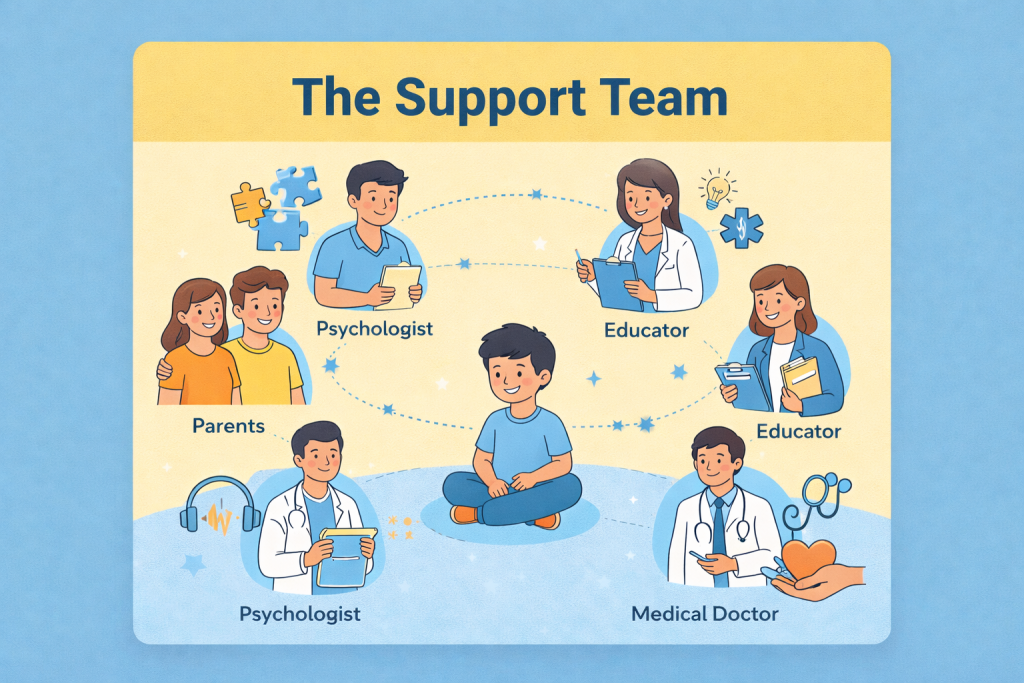
The Core Autism Support Team
1. Parents / Primary Caregivers (The Heart of the Team)
They provide:
- Safety and emotional regulation
- Structure and predictability
- Advocacy and long-term support
- Consistency across all environments
They are not “helpers” — they are leaders and co-therapists in the child’s life.
2. Occupational Therapist (OT)
This is the most essential professional for autistic development.
They help with:
- Sensory regulation
- Body awareness and motor planning
- Executive functioning and focus
- Emotional self-regulation
- Daily living skills (independence, routines, hygiene, self-care)
An OT teaches the nervous system how to feel safe and organized.
3. Speech & Language Therapist
Not just for talking — for understanding and expressing the inner world.
They support:
- Functional communication
- Emotional language
- Social understanding
- Processing and comprehension
- Alternative communication methods if needed
They help the child connect with others and reduce frustration.
4. Educational Specialist / Learning Facilitator
Especially important for home-based or adapted learning.
They:
- Adapt the curriculum to the child’s processing style
- Teach at the child’s pace
- Focus on strengths and interests
- Build academic and practical skills
- Reduce learning anxiety
The goal is education that builds capability and confidence.
5. Psychologist or Neurodevelopmental Therapist
Supports:
- Emotional processing
- Anxiety and stress management
- Behavioral understanding (not correction)
- Family support and guidance
- Coping strategies for overwhelm
They help the child make sense of their internal experiences.
6. Medical or Developmental Doctor
Helps monitor:
- Sleep
- Nutrition
- Gut health
- Sensory and neurological differences
- Medication where appropriate
- Co-occurring conditions (ADHD, anxiety, epilepsy, etc.)
They ensure the child’s biology supports their development.
7. Neurofeedback or Regulation Specialist (Optional but Powerful)
Helps:
- Improve attention and focus
- Reduce emotional reactivity
- Support nervous system stability
- Build cognitive regulation
Especially helpful for children who struggle with school demands and attention control.
8. Mentor / Strength-Based Coach
This person:
- Encourages the child’s interests
- Builds self-esteem and identity
- Supports real-world skills
- Acts as a bridge between childhood and independence
- Helps them feel understood, not corrected
For teens, this role can be transformational.
How the Team Functions Together
| Role | Purpose |
|---|---|
| Parents | Safety, leadership, consistency |
| OT | Regulation, daily functioning |
| Speech Therapist | Communication and understanding |
| Educator | Learning and growth |
| Psychologist | Emotional support |
| Doctor | Biological health |
| Neurofeedback Specialist | Focus and regulation |
| Mentor | Identity, strengths, independence |
The Guiding Principle
Autism support works best when:
- The child feels safe
- The team respects their neurotype
- The environment is adapted, not forced
- Strengths are developed, not suppressed
- Independence is the long-term goal
Autism is not something to “fix.”
It is something to understand, support, and empower.