This post is not to mock or make fun of the African Traditional System, but to highlight that there can be support for the Autistic family no matter the environment. Most systems today are are very Westernized and some times does not take into account cultural and spiritual believes. This post looks at how a Traditional Healer might support someone who is Autistic and might not have access to a clinic or for the family that want to combine both Traditional and Western ideas.
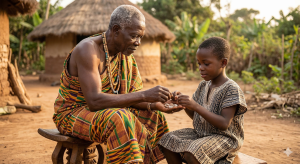
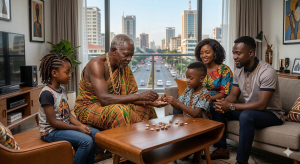
Images generated in Gemini
Whether in a more traditional setting or Urban setting many African families do still count on Traditional Healers for guidance.
In many African traditional systems, health is understood as a balance between body, mind, spirit, and community, not just biology. So when a traditional healer or sangoma supports an autistic person, the focus is often on restoring harmony and grounding the individual, rather than changing who they are.
Here is how a Traditional Healer or Sangoma might approach helping an Autistic child:
- A Traditional Healer or Sangoma would first observe and listen not just to symptoms, but to the person’s energy, behaviour, and emotional world. They might see autism as a different way of being called to the spirit, or as someone who walks between worlds — the physical and the spiritual — rather than as a sickness. In some African traditions, children who are highly sensitive to sound, touch, or emotion are seen as “gifted” or “spiritually attuned”. The role of the healer is to help the family understand that this is not a curse, but a difference that needs balance, care, and protection.
2. Because many autistic individuals experience sensory overload or emotional dysregulation, traditional practices that focus on grounding can be very supportive.
These might include:
- Water rituals or baths with herbs such as imphepho, umhlonyane, or lengana to calm the spirit.
- Smudging with imphepho to clear overwhelming energy.
- Gentle earth connection rituals — walking barefoot on soil or sitting near a fire — to stabilize the nervous system.
(These practices can be done safely and respectfully, but always avoid ingestion of herbal remedies unless guided by a qualified herbalist and approved by a healthcare provider.)
3. Traditional healers sometimes prepare mild herbal infusions to help with:
- Sleep and relaxation (e.g., imphepho (herbal mixture of various plants), umhlonyane (African Wormwood), rooibos)
- Digestive comfort — as gut issues are often linked with stress
- Focus and calm (some use adaptogenic plants like African wild sage, but care is needed)
A Traditional Healer or Sangoma would ensure that any herbal approach does not conflict with prescribed medications or medical advice.
4. Drumming, singing, and dancing are central to many African healing traditions — and interestingly, these can be very regulating for the autistic nervous system.
- Drumming can provide rhythmic sensory input that calms overstimulation.
- Chanting or humming can soothe the vagus nerve, promoting relaxation.
- Movement rituals allow self-expression without the demand for words.
These can be adapted gently to the person’s sensory comfort — avoiding loud or chaotic environments if overwhelming.
5. If a healer perceives spiritual imbalance — perhaps ancestral restlessness or generational disharmony — they may perform ancestral appeasement rituals. The purpose isn’t to “fix” autism but to bring peace, understanding, and protection to the individual and family. A calmer, spiritually grounded family environment often helps the autistic person feel safer and more accepted.
Integration with Modern Care
The most effective path is collaboration, not opposition.
Traditional healing can complement modern therapies like speech therapy, occupational therapy, or nutritional support.
The healer’s role becomes one of spiritual and emotional guidance, helping the person feel seen and valued in their wholeness — while medical professionals support biological and developmental needs.
A look at Autism in other cultures
Autism has always existed across cultures, but its interpretation depends on worldview, spirituality, community structure, and concepts of personhood.
Here is a look at so of the other cultures point of views:
Indigenous North American Traditions
Many traditional Indigenous nations did not classify neurological differences as disorders.
How autistic traits were viewed:
- Deep focus → seen as a gift for tracking, craft, or spiritual work
- Limited speech → sometimes viewed as spirit-listening or inner wisdom
- Sensory sensitivity → interpreted as heightened awareness of nature or spirits
- Social difference → accepted within kinship systems
Support system:
- Role-based integration (hunter, artisan, healer’s assistant, storyteller)
- Community caregiving rather than individual therapy
- Non-forced communication styles
Some tribes describe such children as “between worlds” or “spirit-touched.”
Traditional East Asian Cultures
🇨🇳 China
Traditional cultural influence still present. Modern Chinese society is highly scientific, yet traditional concepts subtly shape attitudes.
Cultural lenses influencing autism perception:
- Confucian ideals → behaviour judged by social harmony and duty
- Family reputation (“face”) → disability may be hidden
- Moral interpretation → parenting sometimes blamed historically
- Academic excellence focus → developmental differences become very visible
Modern shift
- Autism now clearly recognized as neurodevelopmental condition
- Rapid growth of therapy centres in major cities
- Increasing public awareness campaigns
Current support pattern
- Intensive parental involvement
- High academic intervention pressure
- Urban vs rural gap remains large
🇯🇵 Japan
Traditional cultural structure meets modern neuroscience.
Japanese society values:
- Predictability
- Social conformity
- Emotional restraint
- Ritualised behaviour
These traits can create both:
✔ Structure that supports autistic regulation
❌ Social pressure to “blend in”
Modern developments
- Strong diagnostic frameworks
- Increasing neurodiversity discourse
- Workplace accommodation still limited but improving
Unique cultural support style
- Schools emphasise routine (helpful)
- Families often provide lifelong care
- Quiet perseverance culture → parents carry burden privately
Important modern insight:
Japan is shifting from “adjust the child” → “adjust the environment.”
South Korea
Traditional collectivism + modern competitiveness
Korean culture strongly values:
- Educational achievement
- Social success
- Family honour
Historically this led to:
- Late diagnosis
- Reluctance to disclose
Modern transformation
- Rapid expansion of autism research
- Government inclusion policies increasing
- Younger generation more neurodiversity-aware
Modern support reality
- Heavy therapy schedules
- Private tutoring culture extends into developmental therapy
- Mothers often primary coordinators of care
Key tension:
Cultural collectivism vs individual neurological difference.
🇹🇼 Taiwan
Often considered one of the most progressive East Asian autism contexts.
Modern characteristics
- Strong special education system
- Public healthcare integration
- Community awareness campaigns
Cultural continuity
- Family-centred care remains core
- Respect for structured routine aligns with autism needs
Taiwan represents a successful synthesis of tradition + modern neurodevelopmental science.
Traditional South Asian (Indian Subcontinent)
Interpretations were often karmic, spiritual, or Ayurvedic.
Possible views:
- A child may be seen as having a special karmic path
- Deep internal focus → linked to meditative temperament
- Repetitive behaviours → sometimes viewed as mantric or ritualistic tendencies
Support:
- Extended family caregiving
- Temple or spiritual inclusion
- Ayurvedic balancing approaches
However, stigma could also exist depending on caste, region, and superstition.
Traditional Middle Eastern & Bedouin Cultures
In nomadic and tribal societies:
- Non-verbal children might be seen as protected by God or spiritually marked
- Strong sensory reactions → interpreted as jinn sensitivity or spiritual permeability
Support:
- Protection rituals
- Strong kinship support networks
- Role assignment within tribe
Traditional Central Asian / Siberian Cultures
Some neurodivergent traits historically linked to shamanic potential.
Traits associated with future shamans:
- Sensory hypersensitivity
- Social withdrawal
- Intense focus or altered perception
- Unusual movement patterns
Anthropologists sometimes call this “shamanic neurotype selection.”
Traditional Pacific Island Cultures
Community-based societies often:
- Normalised behavioural diversity
- Used collective caregiving
- Valued specialised skills over social conformity
A child with autistic traits might:
- Become expert in fishing patterns, navigation, craft, or ritual knowledge