(Rewritten 2026 — updated from the original 2017 post to reflect what I’ve learned since, with clearer distinction between peer-reviewed research and functional-medicine theory)
A note before we start
When I first got Alex’s MTHFR results in 2017, I went deep into functional medicine sources trying to understand what it all meant. Some of what I found and wrote about back then held up. Some of it didn’t. This rewrite keeps the real research, drops the parts that were presented with more certainty than the evidence supports, and is upfront about which is which.
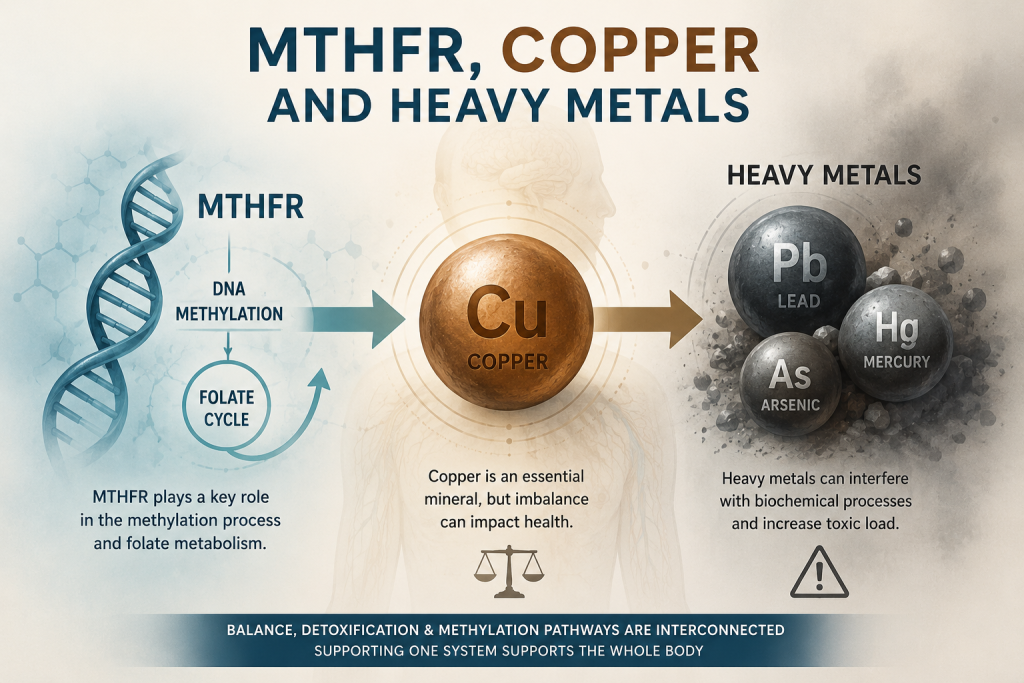
Copper and the Body
Copper is an essential mineral — your body needs it for iron metabolism, nervous system function, and enzyme activity. Too little or too much can both cause problems, but “copper overload” as a specific, diagnosable syndrome with a defined symptom checklist isn’t a recognized medical diagnosis. It’s a concept used in some functional and alternative medicine circles, built around a plausible-sounding but not well-established framework.
What the actual research shows is more mixed than that framework suggests:
- A meta-analysis of around 29 studies found hair copper levels were lower in autistic children compared to non-autistic children, while blood/serum copper levels showed no significant difference between groups.
- A separate case-control study conducted in Saudi Arabia found higher levels of toxic metals like lead and mercury, alongside lower levels of essential minerals including copper, in hair samples from autistic children compared to controls.
- A large Norwegian pregnancy cohort study found that both unusually high and unusually low prenatal copper exposure were associated with increased odds of autism and ADHD diagnoses in children — suggesting balance matters more than a simple “too much is bad” model.
- Separately, a U.S. adolescent study found that those in the highest quartile of salivary copper had a meaningfully increased likelihood of an ADHD diagnosis compared to the lowest quartile.
What this means: copper’s relationship to neurodevelopmental conditions is real, actively studied, and genuinely complicated — different tissue types (hair, blood, saliva) show different, sometimes contradictory patterns, and results vary across populations and study designs. That’s a reason for interest and further research, not a reason to self-diagnose “copper overload” or start a supplement protocol based on it. If copper is a concern, it’s something to raise with a doctor who can order proper blood work and interpret it in context — not something to address through unsupervised functional-medicine protocols.
(If it builds up due to a genuine inability to clear it, that’s a separate, serious, and rare medical condition called Wilson Disease, diagnosed and treated by a doctor — not something inferred from a symptom checklist.)
Heavy Metals
Heavy metals like lead, mercury, arsenic, and cadmium are genuinely toxic at meaningful exposure levels, and lead poisoning in particular is a well-established, serious pediatric health issue with clear diagnostic criteria (blood lead level testing) and established treatment protocols when levels are actually elevated.
Where the research stands on heavy metals and autism specifically: it’s mixed and still developing, as the copper studies above show. There’s enough signal to justify continued research, but nothing that establishes heavy metal exposure as a cause of autism, or metal reduction as a treatment for it.
On chelation therapy — this needs to be said clearly
Chelation therapy is a real, legitimate medical treatment — for confirmed, diagnosed heavy metal poisoning, prescribed and closely monitored by a doctor, typically in a hospital or specialist setting.
It is not a general “detox” tool, and using it for autism, without a confirmed poisoning diagnosis, is not supported by evidence and has caused real harm. In 2005, a five-year-old autistic boy died of cardiac arrest during chelation therapy administered specifically to address a presumed heavy-metal cause of his autism, after being given the wrong form of a chelating agent, which caused a fatal drop in blood calcium. This wasn’t an isolated incident — it was one of three chelation-related deaths reported to the CDC between 2003 and 2005. A subsequent clinical review concluded plainly: “The use of chelation therapy in autistic children has not been validated and can have tragic consequences.” This is why the American Academy of Paediatrics and mainstream medical bodies explicitly warn against using chelation for this purpose.
I wrote about chelation more favourably in 2017, presenting it as an option with the right precautions. I no longer stand by that. If heavy metal exposure is a genuine concern, the right step is proper testing and a conversation with a doctor about whether treatment is actually indicated — not a self-directed or functional-medicine-guided “detox” protocol.
On “chelated minerals” — a genuinely different, low-risk thing: it’s worth distinguishing this from chelation therapy. “Chelated” mineral supplements (like zinc glycinate or magnesium bisglycinate) simply mean the mineral is bound to an amino acid for better absorption — this is a common, low-risk supplement formulation choice, not a medical procedure, and shouldn’t be confused with chelation therapy despite the shared word.
Where this leaves copper and heavy metals
MTHFR variants are common — research suggests roughly a quarter of people worldwide carry at least one copy of the most-studied variant, more in some populations — and they can genuinely affect how the body processes folate. That’s real and worth understanding. Where I’d urge caution, looking back at what I wrote in 2017, is in how far that understanding was stretched: into copper overload, methylation-status frameworks, detox sequencing rules, and ultimately chelation. Most of that reflects functional-medicine theory rather than established medical guidance.
If you’re investigating your own or your child’s health after an MTHFR result, the useful next steps are the boring, reliable ones: proper bloodwork, a doctor or geneticist who can interpret it, and treating confirmed deficiencies or conditions as they’re actually diagnosed — not a broad protocol built around a single genetic marker.
This post is a focused, updated look specifically at copper and heavy metals. My original 2017 post also covered glucose regulation and malabsorption — those sections have held up reasonably well and weren’t part of this correction, so if you want the fuller picture, you can read the original post here.
Sources
- Meta-analysis, hair vs. blood/serum copper levels in ASD (~29 studies) — PubMed ID 36933002
- Case-control study, hair heavy metals in ASD, Saudi Arabia — PubMed ID 22473261
- Norwegian pregnancy cohort, prenatal metal exposure and ASD/ADHD outcomes
- U.S. adolescent salivary copper and ADHD risk study
- Baxter AJ, Krenzelok EP. “Pediatric fatality secondary to EDTA chelation.” Clinical Toxicology. 2008;46(11):1083–1084.
- CDC. “Deaths Associated with Hypocalcemia from Chelation Therapy — Texas, Pennsylvania, and Oregon, 2003–2005.” MMWR. 2006;55:204–207.
- AAP. “Deaths Resulting From Hypocalcemia After Administration of Edetate Disodium: 2003–2005.” Pediatrics. 2006;118(2):e534.