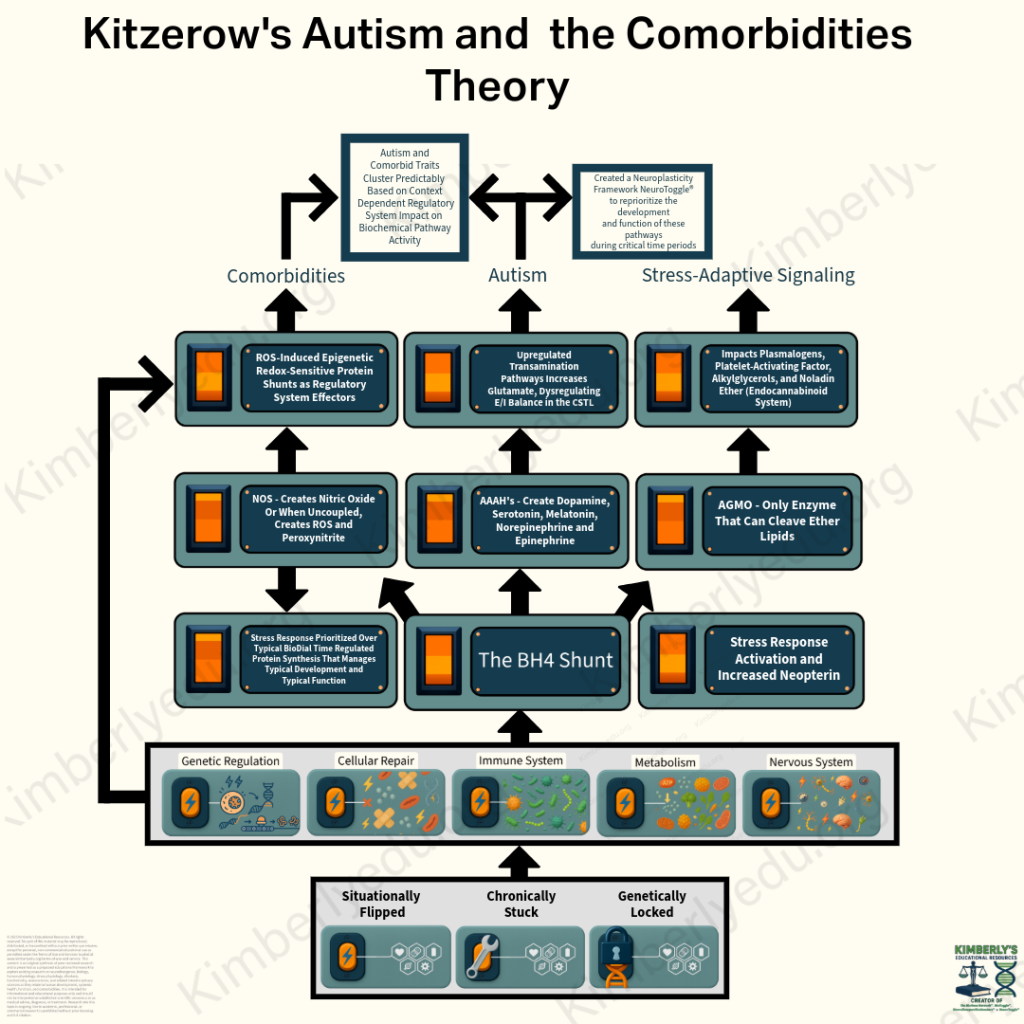
Image from the Website: kimberlyedu.org
So, what is the Kitzerow’s Autism and the Comorbidities Theory
Kitzerow’s Autism and the Comorbidities Theory proposes that autism itself may not be a singular, uniform condition, but rather a cluster of traits and differences that often occur alongside other medical or neurological conditions (comorbidities).
In simpler terms:
- Autism may often coexist with other physical or mental health conditions.
- The theory suggests that some challenges attributed to autism might actually come from these co-occurring conditions, not from autism itself.
- By addressing the comorbidities, the quality of life and functional outcomes for autistic individuals could improve, even if core autistic traits remain.
Key Points of the Theory
a. Autism is heterogeneous
Autism is highly variable; each autistic person may have:
- Different levels of social communication differences.
- Different sensory sensitivities.
- Distinct patterns of repetitive behaviors.
This heterogeneity may partly be explained by which comorbidities are present.
b. Comorbidities are common
Kitzerow emphasises that many autistic individuals experience additional conditions, such as:
- ADHD – affects attention and impulse control.
- Anxiety or depression – can amplify social difficulties.
- Epilepsy or other neurological conditions – can impact cognition or behavior.
- Gastrointestinal disorders – can affect behavior and overall health.
- Sleep disorders – can exacerbate fatigue and cognitive differences.
c. Comorbidities influence expression of autism
Because these comorbidities interact with the brain and body, they can modulate how autism is expressed. For example:
- Anxiety can make social communication more difficult than the core autistic traits alone would.
- Gastrointestinal pain or discomfort can worsen irritability, rigidity, or sleep problems.
d. Implications for diagnosis and treatment
Kitzerow suggests that:
- Clinicians should screen for comorbidities whenever autism is suspected, rather than attributing all difficulties to autism.
- Treatment should target both autism-related challenges and comorbid conditions.
- Addressing comorbidities may reduce “functional impairment” without changing core autistic traits.
Why This Theory Matters
- Shifts the focus from deficit to complexity:
Instead of viewing autism only as a disorder, it encourages seeing it as a complex interplay of neurodivergence and coexisting health factors. - Encourages personalised care:
By identifying comorbidities, healthcare can become more tailored. For example, treating anxiety, sleep issues, or digestive problems can significantly improve daily functioning. - Explains variability in autism:
Two people with similar core autistic traits might have very different abilities or challenges depending on which comorbidities they have.
Example Scenario
Imagine two autistic children, both with social communication challenges:
- Child A: Has mild autism, no major comorbidities. Functions relatively well at school and home.
- Child B: Same core autistic traits, but also has ADHD, anxiety, and sleep difficulties. Experiences significant challenges in learning, social interaction, and behaviour.
Kitzerow’s theory would suggest:
The additional difficulties in Child B are not solely due to autism—comorbidities amplify them. Treating these comorbidities could improve overall functioning, even if their autistic traits remain.
Who developed this theory?
Monika Kitzerow is a researcher and parent advocate (also a mother to an autistic daughter) whose work centres on autism understanding, family experiences, and inclusive education. She is known for connecting academic research with lived parental perspectives to improve support systems for autistic individuals and their families.
Her website: Kimberlyedu.org
Facebook page: Kimberly’s Educational Resources
This is my view on Autism as well and part of the reason for this website, Autism is not just one thing – there is more to it than what you see.