PUFA Metabolism: How Your Body Processes Healthy Fats
When we talk about healthy fats, we often hear words like omega-3, omega-6 and PUFA. But what actually happens to these fats once we eat them?
This is where PUFA metabolism comes in.
PUFA stands for polyunsaturated fatty acids. These are types of fats that the body needs for many important jobs, including building cell membranes, supporting the brain and nervous system, and producing substances that help regulate inflammation.
The interesting part is that the fats we eat are not always in the exact form the body needs.
Our body has to process and convert some of these fats into other forms.
Think of it like a food-processing factory.
We eat the raw ingredients, and the body uses enzymes to turn those ingredients into different products that can be used by the cells.
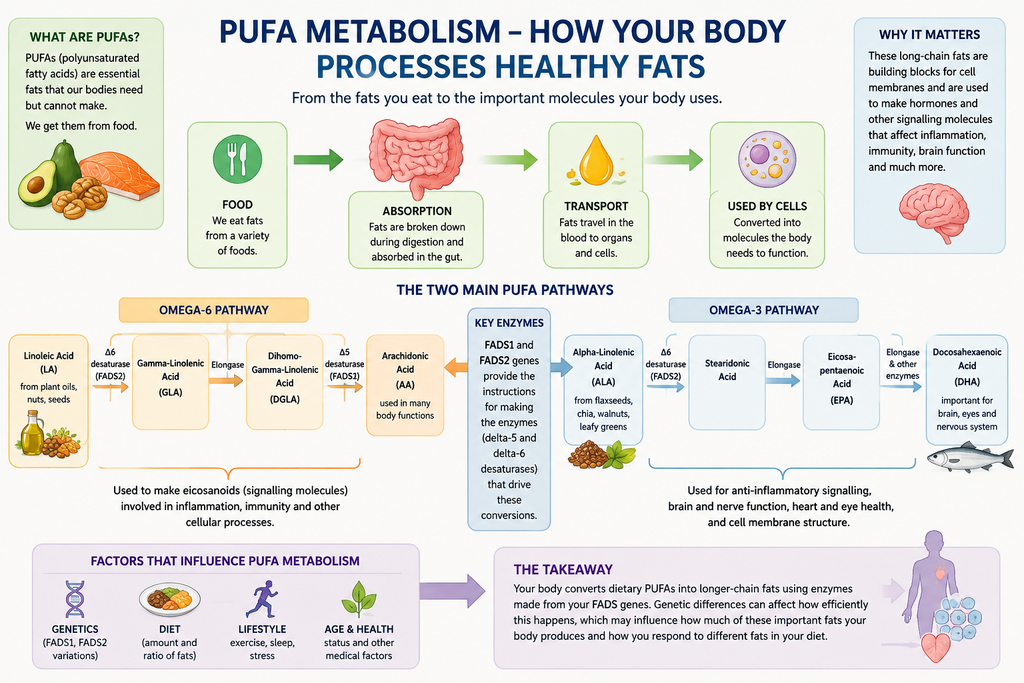
So, what happens to PUFA?
There are two important families of PUFA that we get from food:
Omega-6 fats
One of the main omega-6 fats is linoleic acid (LA).
The body can process LA through a series of steps to produce other fatty acids, including arachidonic acid (AA).
These longer-chain fats are used by the body to make important signalling substances involved in things such as inflammation, immune responses and other cellular functions.
Omega-3 fats
One of the main plant-based omega-3 fats is alpha-linolenic acid (ALA).
The body can also process ALA through a series of steps to produce longer-chain omega-3 fats, including EPA and, to a lesser extent, DHA.
EPA and DHA are particularly important because they play roles in the brain, eyes, cell membranes and the body’s inflammatory response.
Where do FADS1 and FADS2 fit in?
This is where genetics becomes interesting.
The body uses special proteins called enzymes to help carry out these conversion steps.
Two important enzymes in PUFA metabolism are called delta-5 desaturase and delta-6 desaturase.
The instructions for making these enzymes come from genes called FADS1 and FADS2.
You can think of the FADS genes as the instructions for the machinery in the body’s fat-processing factory.
If the instructions differ slightly from person to person, the machinery may work a little differently.
And this is where your DNA result comes in.
FADS1 Result
The genetic result being looked at here is:
FADS1 – rs174537
Your result: GG
A SNP, pronounced “snip”, is simply a small difference in our DNA.
We all have genetic variations. They are not automatically good or bad. They can simply mean that our bodies may handle certain things slightly differently.
The FADS1 gene helps the body process certain polyunsaturated fats, particularly during the conversion of shorter-chain fatty acids into longer-chain fatty acids.
Your GG result is associated with relatively higher FADS1 activity compared with people who carry the T version of this particular genetic variant.
In plain language:
Your genetic result suggests that this particular part of your body’s fat-processing system may work relatively efficiently.
That can influence how much of certain longer-chain omega-3 and omega-6 fats are produced from the fats you eat.
Why does this matter?
Imagine two people eating similar foods.
Both eat foods containing plant-based omega-3 and omega-6 fats.
Their bodies may not necessarily process those fats in exactly the same way.
One person’s genetic “machinery” may convert them more efficiently, while another person’s may convert them less efficiently.
This is one reason why there isn’t necessarily one perfect diet that works exactly the same way for everyone.
Our genes can influence how our bodies handle nutrients.
Does GG mean you don’t need omega-3?
No.
This is an important point.
A genetic result does not tell us that someone should stop eating omega-3 foods or that they don’t need them.
It tells us about a tendency in one part of the body’s processing system.
What someone actually needs depends on many things, including their diet, age, overall health, lifestyle and the amount of different fatty acids already present in the body.
And there are other genes and enzymes involved in PUFA metabolism too. The body, unfortunately, did not design its instruction manual for easy reading.
What can we learn from this result?
The most useful way to look at a genetic result is not:
“Is this gene good or bad?”
Instead, ask:
“What does this tell us about how this person’s body may work?”
In this case, the FADS1 result gives us information about how the body may process certain dietary fats.
It helps add another piece to the bigger picture of nutrition and health.
The simple version
PUFAs are important fats that the body uses for many different functions.
FADS1 and FADS2 are part of the body’s machinery for processing these fats.
Genetic differences in these genes can make this processing system work differently from person to person.
The GG result for FADS1 rs174537 suggests relatively efficient activity of this particular enzyme pathway.
It is not a diagnosis, and it does not tell us exactly what someone should eat.
Instead, it gives us one more piece of information about how that person’s body may handle fats.
And that is the fascinating part of looking at DNA.
Your genes don’t completely determine what your body does.
They provide the instructions.
What you eat, how you live, your environment and many other biological factors all help determine how those instructions are actually used.
Salt Sensitivity
Salt is another example where people can respond differently.
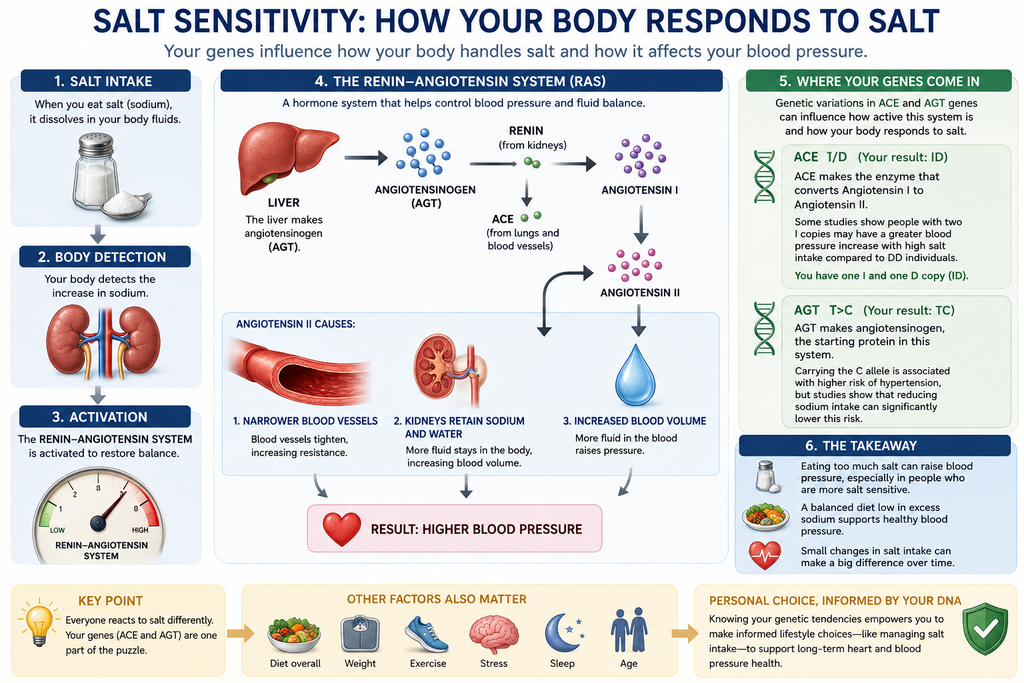
When we eat salt, the body has systems that help control the amount of salt and water in the bloodstream.
This is important because the amount of fluid in the blood affects blood pressure.
One of the major systems involved is called the renin-angiotensin system.
You don’t need to remember that name. Think of it as one of the body’s blood-pressure control systems.
Two genes in this system that appear in these results are ACE and AGT.
ACE: The Blood Pressure Control System
The ACE gene provides instructions for making angiotensin-converting enzyme.
This enzyme is part of the system that helps regulate blood pressure and fluid balance.
Your result is:
ACE – I/D
Result: ID
“I” means an insertion of a small piece of DNA, while “D” means a deletion.
So an ID result means that you have one copy of each version.
Research has found differences in how blood pressure responds to high salt intake depending on ACE genetic variation.
However, it is important not to overinterpret this particular result.
Some studies have reported a stronger blood-pressure response to high salt intake in people with certain ACE genotypes. The study quoted in the report specifically compared people who had two I copies (II) with people who had two D copies (DD).
Because this result is ID, rather than II or DD, we cannot simply say:
“This person will have high blood pressure when they eat salt.”
That would be taking the genetic result further than the evidence allows.
Instead, the result tells us that ACE is one of the genes involved in the body’s blood-pressure response to salt, and that genetic differences in this system may contribute to differences between people.
AGT: Another Piece of the Blood Pressure Puzzle
The second result is:
AGT – T>C
Result: TC
The AGT gene provides instructions for making angiotensinogen, a protein involved in the body’s blood-pressure regulation system.
Your result contains one T and one C copy.
Research has associated carrying the C allele with an increased risk of hypertension in some populations.
Interestingly, studies have also found that people carrying this allele may benefit particularly from reducing sodium intake, with lower rates of hypertension among those who reduced their sodium consumption.
In everyday language:
Your AGT result suggests that keeping an eye on salt intake may be particularly relevant to your blood-pressure health.
Again, this is about risk and tendency, not destiny.
Having a particular genetic variant does not mean that someone will develop high blood pressure.
Blood pressure is influenced by many things, including:
- genetics
- salt intake
- overall diet
- body weight
- physical activity
- stress
- sleep
- age
- kidney function
- other health factors
Genes are only one part of the picture.
PLEASE NOTE: ANY VIEWS REGARDING THE RESULTS ARE MY UNDERSTANDING AND DO NOT SERVE AS PROFESSIONAL ADVICE. THE TREATMENT RECOMMENDATION IS STRICTLY RELATED TO ALEX’S RESULTS AND NOT MEANT FOR SELF-TREATMENT. ALWAYS SPEAK TO YOUR HEALTHCARE PROVIDER BEFORE STARTING ANY TREATMENTS.